Sunday, June 5, 2011

World Environment Day


World Environment Day – Plant a tree towards a greener, cleaner World

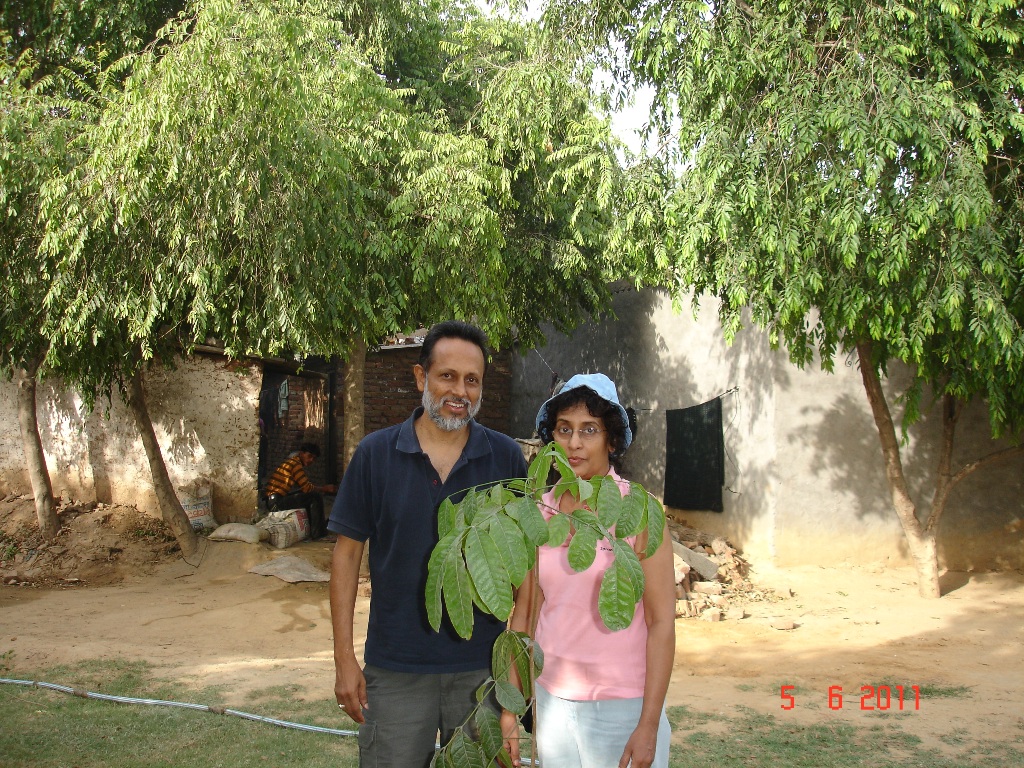
Three people planted 7 plants .

A small step for a man and if every one participates it could be a Giant leap for Mankind!!. Remember Neil Armstrong’s words on setting his foot on the moon.


World Environment Day, WED in short started off in 1972 as a global annual event to celebrate positive environmental actions. This is one of the biggest and widely celebrated events towards a better environment. Though these activities go on continually around the globe, 5th June of every year is designated as WED. A day to stimulate awareness among various sections of public, get people together to take some initiatives towards a greener world.

Being a resident of the millennium city Gurgaon was delighted to know from the Organization called “IAMGURGAON” that in August 2011 we the people of Gurgaon will be planting 5,00,000 saplings. It sounded an aggressive goal but unless you aim high we wont achieve much. This reminds me of my management days’ BHAG in short for Big Hairy Audacious Goal. That worked very well for me. Hope it does help us making Gurgaon renamed as Green City.

To help in this endeavor, me and my family got up early on the morning of 5th June 2011 and with the help of DLF horticulture team planted 7 saplings in the park in S-Block of DLF Phase III of Gurgaon, India. I was very happy to hear that DLF has offered to water these plants and maintain them..

Hello IAMGURGAON, now you have to only plant 4,99,993 plants in August.

I read an article about shortage of clean blood in India due to lack of participation by public in Voluntary Blood Donations. The article said that in India, if every man (used in general sense to depict human being) were to donate ONCE in their life there will be no shortage in the country. On the same analogy if every man plants a tree imagine what the world would look like GREEN!!

Today three of us planted 7 trees, imagine what we can achieve in Gurgaon with an estimated population of over 10 lacs (The figures could be much more).

Gurgaonites, let us make it happen, let us make the dream come true – Green and Clean city. Pick up a spade and a shovel, plant a tree and nurture it

Sunday, February 6, 2011

Revisiting Har Ki Dun

Revisiting Har Ki Dun

There was a miniscule of a mention in the local newspaper about a “Talk on a Trek to Har Ki Dun” at the India Habitat centre. Such a small news for a such a mega trek.

Having done the trek recently to this “God’s Own Valley” I still decided to listen to this talk. Why? You may ask. It is because the talk is to be by “Young Senior’s” as they are aptly called. All of the small team of three veterans are above the age of 70!!. The youngest was 72 years young and the oldest at 78.

It was incredible to listen to their trek details. More than the actual route and the description of the place, the attitude of the team to muster energy and do this arduous trek is remarkable. One of them, the 78 year young veteran had been doing regular walk of 3 hours a day and never skipped it. It is a lesson to be learnt from him. Keep fit.

One of them started trekking at the age of 76, so folks it is never too late to do anything. They are all industrialists and had been on many a treks together – the three musketeers they call themselves.

We, the younger group in their 60’s should take this as an inspiration and start atleast a walk if not a trek. And all the younger folks don’t even wait, start trekking. It is such an adventurous sport, so rejuvenating. Added to this is the benefit of seeking the various planets and their satellites. The skies are so clear, void of any pollution and you can clearly see the stars and the milky way. Take a good binoculars and you can spend hours gazing at the beautiful stars in the galaxy.

It was worth the trip to the Habitat centre for the talk. I am planning to do something similar in Gurgaon if there is an organization like The Himalayan Club to sponsor.

With three cheers to the trio.

Tughlakabad Fort Visit

Tughlakabad Fort Visit:

It was the death anniversary of the Great Mahatma Gandhi. A day to remember. It was also a Sunday, 30th Jan 2011. Felt like a walk, a long walk but with a purpose.

Thanks to a news item in the Timeout magazine I came to know about the heritage walk at Tughlakabad fort.

It is a common nature NOT to visit interesting places when they are very close. There is this feeling that as it is so close we can visit it at anytime, but this ‘visit’ never happens. Tughlakabad fort is one such place, right in the middle of the capital city of Delhi but never visited it in the last 25 years I had been here.

The Heritage walk was organized by India Habitat Centre and the lead was Mr Sunil Raman, a freelance journalist. Me and my friend joined the group at 3pm at the fort. It was quite a big group. Surprised to see so many people being interested in revisiting history.

The entrance is majestic and the fort from inside looks huge with its boundary walls not because it was forming the most part of the ruins. They used rubble masonry, consisting of rubble type of stones with mortar. We walked along the wall to a “baoli” a step well. It was very deep but no water. There are a few such wells in Delhi, the one in Mehrauli was neat and magnificent.
There were only ruins of the so called residential buildings. Unfortunately not much about the place is known as there were no records in history. All the documentation ever talked about was about the ruins of Tughlakabad fort. Nobody wrote about the fort in its original form.
The Fort was built Giyasuddin Tughlak, a governor of Turkish origin. He reigned over the western provinces in a very prominent way. It was between 1321 and 1325 AD, that Tughlakabad was founded, 8 kilometers from the Qutab. They say that after 5 years the place was never used again. There are theories that it was abandoned due to lack of water but not authentic. According to certain legends, Tughlakabad was devastated due to the curse of a religious leader, sufi saint named Nijamuddin. There were eleven rulers from the Tughlak dynasty but only the first three generations were interested in architecture raising mosques, , madrasas and laying canals

Across the road (earlier a water causeway) is the tomb of Giyasuddin Tughlak. It was a very simple construction with out much of art work. This tomb seems to be in good shape and well maintained.

There seems to be no efforts being made to maintain this place. How can Government do it if they charge a pittance as entry fee of Rs5/-. This may be a rouge to get more visitors. I think the interested will come irrespective of the entry fee (within reasonable amount).

On the death anniversary of Mahatma Gandhi I should have been at the Rajghat, instead I was at the Giyasuddin Tughlak’s tomb. But as you know Rajghat is so near so can visit it any time.

Sunday, December 26, 2010

Visit to Bio-diversity park in Gurgaon


The millennium city, Gurgaon is mushrooming with concrete buildings. They are spreading at a fast pace depleting the green areas of the region. Coming from Vasant Kunj, a DDA colony we miss their small parks spread in every block. From my 7th floor apartment I can only see just one park (the jogging track inside is just 0.25km – imagine the size of the park).

Thanks to the Haryana Government and the stress on eco-centric environment birth of a bio-diversity park has happened. Felt so very happy to hear about this and added to the delight is that it is situated so close to my house.

You might not have noticed it as it is not easily seen from the MG Road though it lies right on it. It lies on the left side of MG Road just before the Delhi Border. One can get a better view from the metro.

On 11th Dec 2010, I made a visit to this place along with my friend and his son. It is just under 3 kms from Bristol hotel. There is a lot of work being carried out, a very good sign. We can clearly see a boundary wall and partly laid out cycle track and some mud foot path. At a distance we can see two mandirs and initially planned to go there. Later we decided just to walk on the ridge to enjoy the rocky hilly area.

On the way we saw a number of trees planted by Gurgaon residents on 5th June. They are growing but seem to be slowly progressing. We also encountered a few people watering the grass and the plants, again a welcome sign. Gives a feeling of being cared (the park). We did find some barbed wire fencing. The area is so huge that we can not see the end of the park even from an elevated ground. We saw a huge basin flanked by rocks on one side, imagined a amphitheatre but later was told by the architects (whom we happened to cross) that it will be a water body. They are planning several water bodies in the park.

Suddenly we came across a small shed displaying STD/ISD on the outside!! So advanced? Communication facilities even before the park is developed!. The journey was good and at one place we saw elephant grass growing wildly and beautiful. We were told that they have plans to remove non-aravali species of plants and plant species which are from these parts.

I am very excited and waiting for it to be developed. It will definitely give us a feeling of an eco-sensitive Gurgaon.


Best of luck to the government authorities and hope we can see its completion soon.

The nearest metro station is Guru Dronacharya. Walk towards the Delhi border on MG road for less than a kilometer.

Friday, December 24, 2010

Visit to Hauz Khas


Being a hard core trekker, my feet were itching for some good exercise after the trek to Har Ki Dun in May 2010. Was browsing through the net and found an organization called Delhi Heritage Walks dealing with such walks in Delhi. Though I am not particularly very keen on monuments but did well in my History at School, could remember the various rulers, dates, etc. Thought this will be a good idea to give my feet some exercise at the same time will help brush up my long forgotten History of old Indian dynasties, rulers and architecture.

I booked myself on a walk through the Hauz Khas village, literally translated into an “important water Tank”. It was a Saturday and didn’t want to take my car out so took the Metro to Green Park. This is the closest metro station to visit Hauz Khas. It was getting late for the rendezvous at the deer park gate so hurriedly took an auto and paid Rs25/-. Reached the gate at about 3:25pm and found a very young crowd, all participants in the walk. There were some journalists, architects, photographers, tourists.

We waited for two more of the participants and started the walk at about 3:35pm. The entry is not from the deer park gate but further down the road. Very inconspicuous gate, would have missed the entry but for the guide.

Hauz Khas was initially built as a water reservoir by Allauddin Khilji in the 13th century. The water from this reservoir was used to supply water to the inhabitants of the village. Later the king Ferozeshah Tughlak renovated it, built the madrasa and a beautiful garden. He also built his tomb which has a unique enclosure bounded by stone structures adjoining the tomb. I was surprised at the massive size of the water tank filled with water. We could see some birds near the lake and a fountain in the middle.

There were mosques in the premises. There we could see some very small rooms with a small ventilators, couldn’t figure out what it was. Looks more like meditation sites.

After visiting the garden, the ‘class rooms’ of the madrasa we entered the deer park and visited more of the historical ruins. There were structures called “Kali ghumbaz”, “Tohfa Ghumbaz” and many more. The park was without the deer (I understand they were kept in enclosures) but heavily wooded. It was beautiful to walk through the park. Never knew such a thing existed right in the middle of the city.

After a 1.5 hrs walk a bit tired but felt good and took an e-rick to the metro. Costed me Rs15/-

We were allowed to take pictures and you can see (above) some of them.


Monday, November 29, 2010

Pabitora Wildlife Sanctuary


The time is around the middle of November, 2010. Delhi is just getting cooler with morning being a bit cold for shorts and a T-Shirt. I usually take a walk in shorts during summers and pre-winters.


We were on our way to the Airport in the wee hours (5a.m) with a bit of nip in the air, making us feel that winters have actually arrived in the capital. Our Indigo airlines (my favourite among the low cost airlines for their servcie as well as on time record) took off as per the schedule (revised). After an hour and half the captain announced that on the left we can see the might Himalayas and of course the towering peak of Everest. My ignorance of the fact we can actually pre-book our preferential seat online put me on the right side of the plane making it difficult to view the mountains. the passenger next to me obliged me (I was sitting in the middle seat on the right of the aisle) by sitting back allowing me to get a better view of the snow capped mountains. It was wonderful. A thought came to me, why cant they have a viewing gallery in the planes for such a flight with full glass structures, like the glass bottomed boats used to see the colorful coral reefs near Maldives and other coasts.


What about the Wildlife sanctuary? We have not reached Guwahati so hang on for a little while.


The flight landed at the International airport of Guwahati on time and we proceeded to our hotel, The Vishwaratna hotel in central Guwahati.


After a day of rest and local sightseeing, shopping etc we proceeded by Toyota Innova to the Pabitora Wildlife Sanctuary. It is about 60kms from the city. Choose a saturday for the other days it may take a long time to get out of the city which is very crowded with narrow roads (afterall I am comparing with Delhi - unfairly).


There is a small restaurant within the sanctuary catering with simple food. After a quick and simple lunch we travelled on a mud road with its own pot holes, ups and downs. AT one point we had to get down so that the van cross a bad patch. Finally we arrived at the Elephant boarding point. It was good we chose elephants instead of the jeeps as jeeps can only traverse the properly laid out mud paths with in the sanctuary where as the elephants can go whee they want to or where the mahout wants to.


At the entrance we had to buy the entry fee, the elephant rides and also pay Rs500 for the Video camera and Rs50 for the still camera. Was it worth it will tell you later. We booked for the 3pm trip and when we rached the boarding point well in time, some high profile Forest folks hijacked our elephants leaving us fuming and complaining to no avail. We had to sit it out for an hour and take the hurried 4pm trip. The sun sets at about 430 to 445pm in these eastern parts of India. This made our trip shorter and not good for my amateurish photography.


The good part was we are on elephants and could go very near to the many rhinoceros roaming the wild flat lands punctuated with some marshy places. SOme of them looked menacingly at us almost posing as if to attack us (actually the elephants as we are miniscule in front of these two mammoth animals)


The mahout was not trained to take care of the tourists and to stop the elephant for us to get a better view, so had to manage by craning my neck and got some good enough shots. We were sitting on elehants with two seaters which made us sit one behind the others instead of a four setaers who coould sit sideways. The forest department should do something to enhance these facilities and train the mahouts.


We saw some wild boars, buffaloes along with some straying cows..


Pabitora has been made a national wildlife sanctuary in 1971 to protect the one-horn rhinoceros. This place is very small with about 86 rhinoceros making it high density makes it easier one to spot this big animal. You will be guaranteed to see one and more in your trip.


If you went to Guwahati and dont have enough time to go to Khaziranga, you should plan a visit to Pabitora. You wont be disappointed.


Till next time ciao!

Saturday, July 3, 2010

A Trip to Jakholi


A trip to Jakholi

I live in Gurgaon, part of NCR (National Capital Region). It is middle of scorching summer with temperatures hovering around 44 deg celcius. There was no respite in the last two weeks and the weather man predicted no changes for the next two to three weeks. Me and my wife wanted to get away from this place. I searched through my mind for any new places to visit in the hills of Uttarakhand and came up with the place called Jakholi.

No one seems to have heard about it, Jakholi. Any unknown place fascinates me. I love challenges so Jakholi sounded great to us. My wife trusts me so much that the name of the place really does not matter, she is accompanying me and that’s what matters. I could not get any help from any one including the Tourism department about its altitude. I didn’t want to land up in a place which is hot too!!. Definitely did not want to be like ‘from a frying pan into the fire’.

It is not that no one knows about it, we know it is a small village block near Rudraprayag. I called up the Tourist guest house at Jakholi and the caretaker told me the altitude is about 6200ft. That sounded ‘cool’. So we booked our accommodation through the internet for about 10 days. Though this place is relatively unknown, the accommodation was not available on one of the days. The caretaker advised me to approach the forest department who has great guest house at Chirbatia and a staff guest house at Jakholi. I called the DFO of Rudraprayag who was very helpful and gave me permission to stay for one night.

So accommodation being taken care of, we eagerly waited for the departure date and on 8th June 2010 we started off in our faithful Honda Civic. The journey was smooth on NH58. There was some construction work happening enroute but did not affect us much.
The plan was to break journey at Deoprayag, the route being Gurgaon, Delhi, Roorkee, Haridwar, Rishikesh, Kaudiyala and then Deoprayag. There were two traffic jams and got delayed. We had lunch at Kaudiyala and proceeded to Deoprayag which we reached about 4pm. A bit tired, not due to the long journey (330kms) but due to the waiting at traffic jams. Checked into GMVN TRH(Tourist Rest House). Very old construction and has basic amenities. It is already much cooler than Gurgaon so enjoyed the evening in the lawns over a cup of tea. The view from this place is good, surrounded by hills. Deoprayag is the place where we have the confluence of the two great rivers, the Bhagirathi from Gangotri and Alakananda from Badrinath. The holy name of Ganges is given to the river flowing from Deoprayag after the confluence. There is a bridge across the Ganges which takes you to Pauri. The bridge is a recent addition (in the last ten years) before which we used route via Srinagar to reach Pauri.

After a restful night at Deoprayag, we started off on our journey to Jakholi. When we reached Rudraprayag, the confluence of rivers Alakananda and Mandakini we took a detour from the highway to the DFO office to confirm our stay at their guesthouse. The road from Rudraprayag to Tilwara, 9kms was fairly good but later it became very bad. I had to crawl in 1st and 2nd gears on this bad road up to Mayali, 19kms. At Mayali we take a right turn towards Jakholi, 8kms. A better road compared to the road to Mayali. The road goes amidst thick forests of Pine trees.

Reached Jakholi by lunch time. The village is split over two areas, one with all the Block offices, banks, Post office etc and the other the actual Village with their dwellings. There are about a dozen shops The GMVN TRH is quite different from the rest with the building in a better shape than most. It had a very nice terrace at 1st floor and the whole roof top is open to the sky. This TRH is perched atop a hillock surrounded by Himalayan range of hills. The temperature is pleasant and cool. It drizzled a bit and nights got colder.


In the morning we could see quite a few of the snow clad Himalayan peaks like Gangotri, Yamunotri, Shivling, Chaukhamba and Nanda Devi. All these from the same spot on the terrace. How lucky and happy to have come to this place.


This is the first time (in our trips), we have decided to stay at one place. I was told that the road to Chirbatia is as as bad as the one from Tilwara to Mayali so didn’t venture to go there on 12th June. Instead we opted to stay at the forest guest house at Liza depot gues house. There was absolutely nothing available at the place but located in the forest. We visited their nursery of Pine, Deodar, Banj Mor Pankha etc . They extract a liquid from the bark of Pine trees by cutting ‘V’ shaped cuts in the bark. This is collected in big Tins and auctioned off for various uses.

I understand that there is a small lake called Badani lake about 25kms from Jakholi. The route takes you through a village called Ranadhar. I didn’t venture again due to very bad road condition. Only a Jeep can go there as it is very bad at certain locations.

There is a small park maintained by the Forest department and about half a kilometer from the TRH which we used to frequent. Our daily routine is to visit the park, visit the shops, buy some things, look at mountains, read books, eat and sleep. It was really wonderful. My wife had the perfect surroundings to do her meditation, prayers and read her ‘God Speaks’ book with full concentration. Absolutely nothing to worry. Life can be really quiet. The Sunrise and the sunset scenes are spectacular from this place.

During our stay we met a few of the travelers who strayed to this place by chance or by recommendation from other GMVN personnel and not by choice. There was a group of eight from West Bengal, returning after a trek to Roop Kund and a few of them went to Ronti Saddle. They seemed to have a lot of energy even after their arduous trek that they went for an evening walk!.

We thoroughly enjoed the place and checked out on 18th and proceeded to another less known places called Hariyali Devi. The route takes us back to Rudraprayag, Nagrasu at which point we take a right turn. The road from Nagrasu to Hariyali devi is narrow and no traffic, looked desolate and scary. It is about 22kms. The road is being repaired though it is already fairly good (I may be comparing after the Tilwara-Mayali ride). The GMVN guest house is hiding on a road to the right and a gravel road with stones. The TRH looked even more scary than the ride to this place. Absolute silence and no one to be seen. The doors were ajar and pushed them and went in, my wife was sitting in the car with doors locked. I shouted ‘any one home?’ but no answer. There was a room with its door ajar and went in to find a man sleeping like a log (supposed care taker). He was the only inhabitant. The time was 230pm. Fetched my wife to see the place, one look and she decided we have to leave at once. The care taker said he will make up the room. It seems there is no electricity and no canteen which means no tea or food and we have to walk to the village every time. Quickly decided to leave the place, the time slowly crept towards 3pm, I am getting worried as we have to reach another TRH before night falls. In these Hills the roads will be blocked for night traffic and one is advised to reach the destination well before dark. We thought about many places like Gauchar, Gwaldham, Rudraprayag, Syalsaur (all which we had visited earlier). Finally after deliberating we decided on reaching Deoprayag (to get as close to Delhi but still be cool). We stopped over at Srinagar GMVN and had Tea. We could not contact Deoprayag TRH but took a chance as it is not on Internet booking site. The road to Srinagar from Rudraprayag is one way for a short distance and we had to take a very bad steep road. Later it joined the NH58 and we had a safe trip to Deoprayag. We were lucky we found accommodation.

The trip from Deoprayag to Delhi was interrupted several times due to the shopping of mangoes on the way. They were so tempting I couldn’t resist from buying, ended up buying about 12kgs.

Reached Delhi by 4pm on 19th June only to find we really fell into the ‘fire’ from a ‘cold frying pan’. This is definitely worse than from falling into fire from a hot frying pan. The moral of the story is don’t come back from such a nice place.